B. Tech., IIT Bombay | Ex-Goldman Sachs, J.P. Morgan, & Merrill Lynch | Author of Cognitive Fitness | Founder of Privacy Cortex, Context Unbounded, Neural Stone & Actual Automation
Author
Anil's First Book
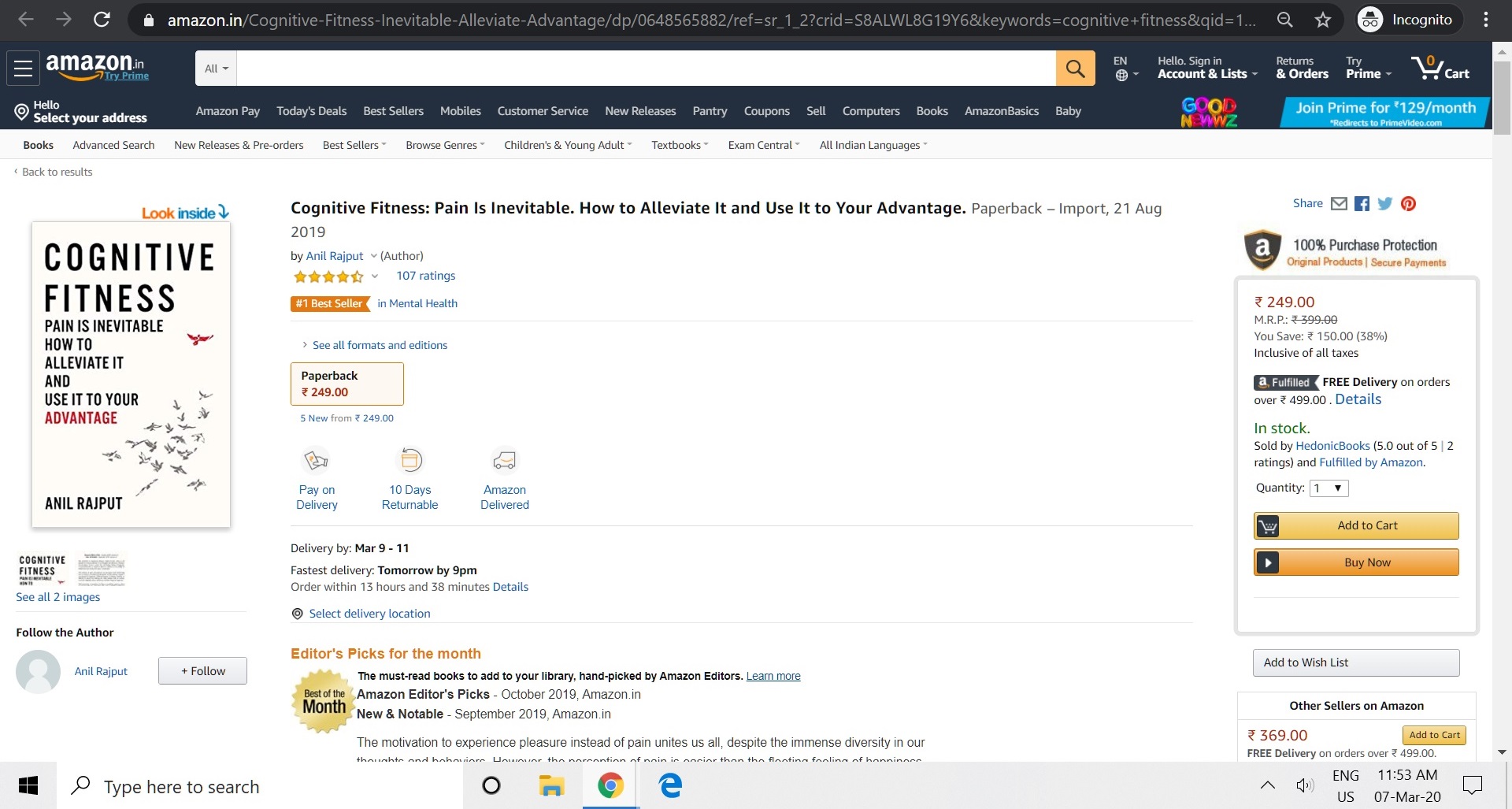
Cognitive Fitness
Pain Is Inevitable.
How to Alleviate It and Use It to Your Advantage.
On Amazon.in
New & Notable, Sep 2019Editor’s Picks, Feb 2020Best of the Month, Mar 2020
On Amazon.com
Bestseller, Nov 2020
The book is temporarily unavailable for purchase as it will be updated and republished.
Why Cognitive Fitness?
The absence of disease and disability means good health; however, for us, fitness is usually achieved with a healthy diet and physical exercise, and a fit body can prevent many miserable medical conditions later in life. Chronic stress or suffering can also slowly and silently harm our health but coming out of an abyss of misery, managing everyday stress, or using our cognitive faculties to their fullest and flourishing needs much more than a balanced meal or a full-body workout.
Health is the greatest gift of life but it may not seem that way until biological functions are on the line—just like the rest of the good—and a fit body and mind can help us to chase our desires or sources of joy, but there is much more to this than meets the eye.
In general, emotions provide feedback and guide our behavior but what feels good can be bad and what feels bad can be good, and even though pain may indicate the presence of a problem, too much misery can paradoxically diminish, not enhance, our ability to solve a complex problem—substance abuse, eating junk food, or a sedentary lifestyle may feel good but experienced happiness does not last as the harm caused sticks and continues to compound; pushing through physical or cognitive boundaries may be unpleasant but such struggle is constructive; and depression is likely to make things worse, not better, for example.
Furthermore, feelings influence our desires, but why we like what we like, or how much wanting is enough, is not always obvious, unambiguous, or conscious and our brains can easily be manipulated or controlled by emotions as we may helplessly engage in self-destructive behavior just to feel good—celebrities too abuse substances for gratification and also die by drug overdose, for instance.
In addition, politicians, corporations, ideologues, and others can comfortably use and abuse our minds for power or profit and individual well-being also depends on functional families and societies—environmental pollution, psychological conditioning, familial disintegration, and ideological poison all affect our state of affairs.
There are endless other factors related to the interaction of body and mind with society and nature and overall, we now use our minds more than our bodies, and physical fitness is the tiniest part of the story and it is the convoluted fitness of cognition that can control both body and mind for the individual, familial, and social good, as far as it is possible.
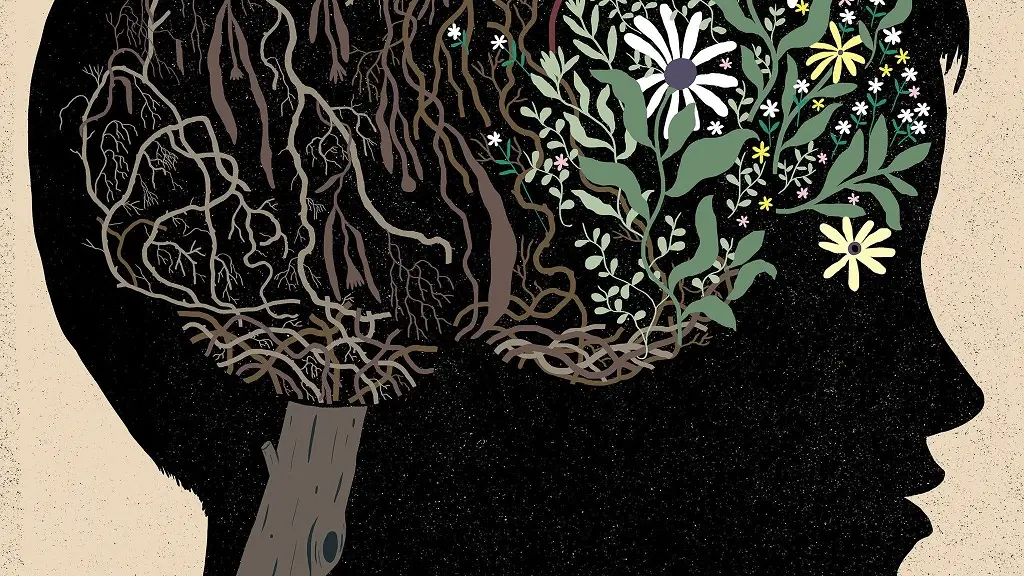
Formulating New Strategies to Minimize & Manage Misery
Making Sense of Science, Systems, Philosophy, Biology, & Reality Together
Why Think New?
Most popular ideas tend to focus on a few domains in space-time but recurrent social self-destruction; unsettled war of ideas and horrors of actual wars; modern weapons of mass destruction; political propaganda in schools, media, and even in the best universities; ideology infiltrating families and facilitating familial disintegration; psychological manipulation of our minds by those who can; unequal distribution of resources and elites using inherent inequality of life for personal gain; money and technology creating countless new pecking orders; political divide and ideological censorship by tech companies; fake studies, reproducibility crisis of soft sciences, and politicization of science; inferior ideas of a few men worshipped by millions as the wisdom of many dies; existentialism and nihilism; pollution in the air, water, land, food, and our bodies; unhealthy lifestyle and stress killing us slowly but silently; thousands of deaths every day because of drug, tobacco, and alcohol abuse; hundreds dying daily by suicide; depression and anxiety becoming all too common; conservative nature of evolution preserving primal neural circuits that can easily override our thinking; ambiguous desires, emotions, thoughts, and behaviors because of interwoven ancient and novel neural circuits and social sculpting; emotions controlling our behavior and intellect irrationally; bounded brains and unnatural information overload; heuristic and imperfect interpretation of reality by biological systems; illusions and delusions making us suffer unnecessarily; habituating happiness and addictions failing to hold on to fleeting joy; brand-new addictions devised by technology; magnificent developments in AI and associated dangers; and so on, suggest that life is not unidimensional and unsophisticated ideas cannot deal with the multifaceted complexity of life.
New ideas are needed that can confront collective genetic, social, and natural complexity and can prevent recurring societal decay and unnecessary suffering.
Upcoming Books
Old Wisdom & Fresh Ideas in a Coherent Whole
God & Religion
Individuals & Institutions
Reality & Truth
Power & Politics
Social Systems
Development & Education
Depression & Anxiety
Pleasure & Procreation
Wanting & Liking
Entrepreneur
Context Unbounded
Neural Stone
Privacy Cortex
Actual Automation
Context Unbounded
Aligning Goals for Neural Circuits & Neural Networks
Resolving Conflicts of Carbon & Silicon Intelligence
Moving from Self-Destruction to Abundance
Managing Context for Frontier AI Coding Sessions
Making Bounded Context of Inference Unbounded
Why Context Unbounded?
Biological and ideological conflicts arising from primal and novel neural circuits, the recurrent self-destruction of companies and societies, individual self-harm, and other things suggest that using intelligence in space-time for collective or individual good is not as easy as it may seem, and now neural networks have entered the scene with frontier AI arriving in 2026.
Science and technology are used in the fights of circuits with weapons of mass destruction, and now a new type of intelligence with huge compute and memory will be used by old circuits for their goals, and AI may have its own goals too in future that differ from ours. AI is being trained on data created by humans, and just like humans are influenced by primal circuits, AI will be heavily influenced by us in an uncertain manner.
Anil was already working on the unification of science, systems, and philosophy for the pragmatic purpose of survival in the long run for humans, and finding ways to enter the mysterious unknown if ever allowed by nature, and AI is another domain to unify with the previous ones. With the positive aspects of abundance of materialistic things by harnessing energy and building at new scale, solving the problem of unequal distribution of biological things and the ideological use of AI for destruction remains. And maybe abundance never arrives, because the fights do not stop and destroy most functional things that exist today.
Anil started Context Unbounded to focus on how to make abundance unbounded, by addressing the biological and ideological aspects of carbon intelligences and how they work with silicon intelligence for collective good. Furthermore, the company also addresses the simple problem of teams not being able to use AI for usual software development, as each inference session is bounded by the number of tokens it can hold and carries nothing into the next one, while a nervous system carries its context forward in an automated manner, and the company’s strategies and products do the same for AI, making context unbounded from session to session.
Fresh Ideas to Define & Defend the Individual & Institutional Good
Why Neural Stone?
Environmental stimulation of the genes during the first 18 years of life sculpts our subjective reality, as well as our physical and cognitive abilities, and as neural circuits can act like neural stones, many beliefs and behaviors—both individual and societal—cannot be changed later in life with logic, reason, or effort alone, causing unnecessary suffering in an already difficult life—it is easier to not start smoking than to stop, and a failed country cannot simply copy what developed countries are doing and become a part of the first world overnight, for example.
Children of today will shape tomorrow but having good genes is not enough. Excellence needs to be developed by exposing the body and mind of a child to nutrition, wisdom, challenges, and other constructive things, not coddling or indoctrination. However, formal education does virtually nothing to develop the ability to think, while parents are busy putting food on the table. Furthermore, elites and ideologues shape social systems and popular ideas, and the best of all is either not on their minds, or the proposed solutions are not sophisticated enough.
It is our primary duty to install awareness of complexity and cognitive competence in children's brains, not idiocy or mediocrity, so that a child can learn to thrive later in life, and we can confront complex challenges collectively too, to the best of our genetic abilities.
Neural Stone aims to suggest new pragmatic and heuristic ideas and solutions that are designed to deal with socio-genetic complexity in space-time, to minimize and manage problems faced by living things and the pain attached to them.
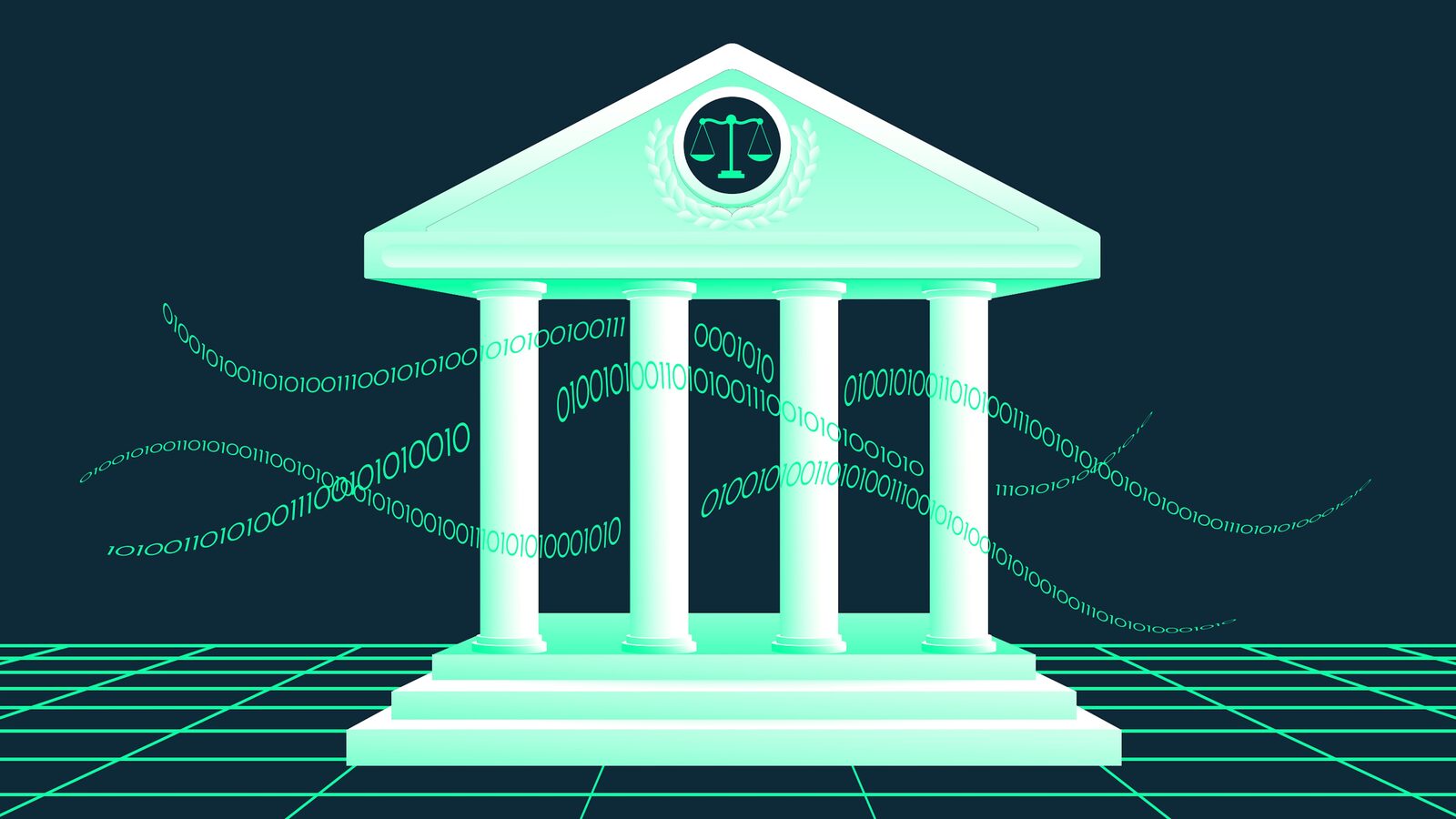
DPDPA Compliance as Legal, Tech, & AI Transformation
Unified Strategy & Products for DPDPA Provisions & AI
Cuts Compliance, Data Management, & Coding Costs
Why Privacy Cortex?
While consulting firms usually offer templates, and product companies service requests, for DPDPA compliance — with penalties from ₹50 crore to ₹250 crore across many provisions — Privacy Cortex focused on legal, tech and AI transformation converging at once, and designed products not only for DPDPA but also to become an essential part of the enterprise context management engine.
The company worked with only two AI models, Fable and Opus, for a few months and built production-grade products for under USD 650 in model spend, with its strategy of context management designed for transformer architecture itself. Its other technical strategies further reduce the cost of compliance and the time to delivery.
It also built AI Team onboarding, within the same cost, where the Team feeds the products with on-demand discovery in enterprise systems, in a non-blocking, draft-only mode for AI governance. This AI discovery includes metadata management so the same token carries the same meaning for all, and a data flow map documenting the most critical context across all systems and connections, among others. It built workflows for GRC controls for humans and AI alike as well, and the same AI Team can help with enterprise context discovery for effective AI use.

After learning that many companies hire software developers to write simple code to automate UI tests, Anil came up with the idea of building an app that not only writes such software but also runs it and reports the results. Early versions of the app will require only the test data and will create the code, but later the app can read a User Story and come up with several UI test cases along with data. This can eliminate the need for automation testers and minimize the work of manual testers while adding many test cases that humans may miss. Advanced versions of the app will be able to create the user story, actual code, unit tests, and UI automation tests from design mockups alone.
It was also observed that business, development, testing, and support teams required different software and services and many processes that could enforce best practices were simply absent. This disconnect and absence caused quality, efficiency, reliability, and visibility issues and it made sense to serve these various needs in one app.
Eliminating the necessity for software developers to write UI automation testing code has been demonstrated without the use of AI, along with integrations of various features needed for SDLC. Furthermore, leveraging AI could feasibly automate actual software development, testing, and support to the greatest extent possible, including writing unit tests automatically.
Following the onset of the coronavirus pandemic, operations for Actual Automation were disrupted and eventually stopped. Although www.actualautomation.com has been taken down, a few details and screenshots of the application can still be found at the following link.

Fitness usually means physical fitness—for us, in the modern world—or reproductive success—survival of the fittest, in biology—but now that physical fitness requires conscious cognitive efforts too and many take their own lives before leaving their genetic copies behind, one may wonder when cognitive fitness and its complexity will be included in the discussion of fitness, so that we can not only be physically fit and survive, but succeed too by making the best use of our intellect.
Simple problems of life can be solved by other brains that are less advanced than ours and we can think and do that which is complex. However, this ability to deal with complexity is itself complicated and in general, many human experiences and behaviors—nihilism, suffering without any apparent reason, medical conditions because of addictions and a sedentary lifestyle, drug overdose deaths, and suicides, for example—are unlikely to be found in other organisms.
Life forms that move in space-time need to have fit bodies to survive and reproduce but we use our minds more than our bodies and while primal neural features are more or less shared among all animals, our higher-order thinking separates us from the rest. Our thinking is the latest and most advanced ability in the evolution of the brain and with mind-boggling capabilities, it has weaknesses too, leading to the possibility of collective or personal harm and the stunning reversal of fundamental longing to live and procreate in many cases. Moreover, the intellect of the human brain is largely untapped and not all of us use it to its maximum. In general, it is the gene-environment interaction that can activate a genetic ability and without trying to break the subjective boundaries regularly, the potential of all the available intellectual—or physical—traits is likely to go to waste and the power of thinking, if not directed toward something good, can be our own worst enemy.
Survival and reproduction are the two primary goals of all life and humans have additional desires, both good and evil. What is desirable and what is not is not yet set in stone and differences in our definitions of right and wrong and ambiguities in our likes and dislikes, both subjective and social, result in secondary motivations and problems that are unique to us.
Thinking can control itself and the rest of the elements of the mind—desires, emotions, and behaviors, for instance—and it can be employed to define good and bad, stop self-destruction or mediocrity, and aim high and succeed, as far as it is possible. Therefore, the fitness of our higher-order thinking—cognitive fitness—must be included in the discussion of fitness.
Conscious cognitive control over the contents of consciousness
Our motivation for action can be good—survive and reproduce, for example—or hedonistic—engage in the pursuit of pleasure only—but what feels good can be bad—eating junk food, a sedentary lifestyle, and substance abuse, for instance—and what feels bad can actually be good—eating healthy food, exercise or self-control, for example—and still, emotions or hedonism can easily overshadow our intellect and force us to engage in irrational or self-destructive behavior. In addition, why we want or like what we want or like, and how much of it is enough, is not always wise, obvious, or conscious, and therefore, managing motivations, emotions, and actions with cognition—to define and defend the good—is a core feature of cognitive fitness.
Physical and psychological fitness can complement each other. Leaving aside genetic and environmental factors that are beyond our direct conscious cognitive control, taking care of physical fitness is straightforward—exercise, eat a healthy diet, maintain a healthy weight, and improve posture. Our ancestors wandered much of the day to find food and were physically fit by default but now we can eat unhealthy processed food all day sitting on our couch. The body is still the same, as it has not evolved in thousands of years and the huge mismatch between the body and the current environment has turned a social solution—easily available food—into a problem—miserable medical conditions and premature deaths because of eating too much and moving too little. The nervous system has also not evolved recently and the mismatch between the mind and the modern environment is extremely complex, causing even more sophisticated social and personal problems. Intellectual interventions are now needed to manage the hidden conflict between genes and the environment and cognitive fitness can facilitate that.
Healthy eating and physical activity can prevent several chronic conditions and cognitive fitness can help in the execution of the steps needed for physical fitness. However, eating a healthy diet or exercising is usually not enough to be fit physically because stress, suffering, substance abuse, and other convoluted things harm our health slowly and silently but dealing with emotions or addictions can be utterly complex. Cognitive fitness can minimize and manage stress—or other detrimental or dismal states—and associated negative side effects on health. However, cognitive fitness can address the overall complexity of life, and therefore, it can get far more convoluted than its counterpart—physical fitness.
Multifaceted chaos and complexity, and cognition
Individual survival depends on the safety of a society, which is usually taken for granted, and hence societal fitness—fitness of ideas floating in a social institution—is also critical, especially when functional societies keep falling with time or some disappear altogether and social systems have also started to pollute our planet, armed with thinking and its products—science and technology.
Thinking is both conscious and subconscious. A mind can generate only a few new functional ideas in a lifetime and thinking has a huge historical influence, both genetic and social. As a result, the fitness of collective thinking, novel and primitive, self-aware and subliminal, matters for the future of humanity. We need to find ways to deal with the social and cortical complexity and protect people and working societies from recurrent external destruction or self-destruction and carefully and collectively advance living systems by using our intellect at its best and keeping track of changes and lessons across extremely large biological and social times.
God Is Not One. God Was Never Dead.
Is God dead, as Nietzsche suggested?
Meaning of God and Religion
Why is the idea that all gods and religions are one and the same extremely dangerous and foolish?
Why is god not one, and why are all gods not the same or good?
Why can all religions not be considered equal or wise?
Why are some religious ideas ideological poison, and why must authentic religions exist to provide an antidote?
Is God real, and what is reality?
What is the meaning of the word "god" anyway and how many meanings are there; and as time moves forward, can these meanings remain the same for one person or society?
God of One or Many
Why can some religions—developed and refined over thousands of years by endless known or unknown people—contain essential philosophical wisdom that the ideology of one mind in one lifetime cannot?
Why is the ability of the nervous system to perceive, encode, store, and retrieve information bounded, and why can one person never come up with all the physics or philosophy?
Why should the ideas of only one person never be identified as a religion?
Can evil be religious too?
God and Stories
Why do unreal stories seem real, and why are some religions encapsulated in stories?
What do gods of religious stories have in common with heroes of modern movies?
Is it easy to ridicule old gods as new ones are worshipped by young minds?
God and Archetype
Why are new gods born when old ones die, and why may new gods not be as sophisticated as old archetypal gods?
Can an archetypal god take an avatar?
How can the death of an archetypal god result in real humans becoming gods and killing millions of people, and how in the future most of us can be wiped out when fake religions or the absence of authentic religions coexist with technology?
As the old archetypal God was mocked, Marx became a new god, and even after untold horror and millions dead, Marxist politics of oppressor versus oppressed is still conveniently used by politicians to gain and retain power.
God and Unknowable
Why do we need language, and how do words and vision, working with other biological systems, reduce the complexity of nature with illusions and computational shortcuts?
Why is the meaning of a word largely subjective and subject to change?
Do we have perceptions, thoughts, and languages to comprehend the unknowable, or are we bounded by the limits of biological systems?
God and Humans as God
Why should real humans of the past or present never be worshipped or elevated to a god?
Why are those who can sing, dance, act, and play the new gods of billions, and what does it tell us about the most popular ideas?
When old values disappear, what fills the gap?
God and Goal
Why can there be no life without an aim?
How does an aim create or change the subjective interpretation of reality?
How can a goal become a personal god?
Why can a living thing never be an atheist?
Science killed old wisdom but can it fix dysfunctional social systems and problems created by applied science?
God and Science
Science may have killed old gods for many, but why can science not answer moral questions or define philosophy?
Why are the tools of science not sophisticated enough to completely unravel chaotic and other extremely complex systems?
Even with presumed superiority over all other things—including god—why can science and technology not stop all death and disease?
Why can social wisdom not be found in a few decades or by science in a laboratory but only in thousands of years of practical living and learning?
Is it possible to make sense of both science and (real) religion?
Why have we settled for physics but not for philosophy?
Why is there so much overconfidence and narcissism in the scientific community?
Why is science virtually absent in failed nations, and why is a functional society a prerequisite for scientific and technological development?
Why can science not fix all dysfunctional societies?
How is science now used as a political tool and a means of mass manipulation to gain and hold power?
How did science create chaotic confusion and nihilism and exacerbate existentialism?
How do we make sense of what is going on and where we are?
God and Systems
How did biological systems come up with the concept of god?
How do social systems carry and change definitions of god over time?
How are technical systems influencing our opinion of god?
Other Questions
Whom should we trust in the confusing war of old and new gods, and why does it matter?
What is reality and if A creates B then can A be more real than B?
Can there be a hierarchy of frameworks, philosophies, or even gods?
Why do religions (nations and organizations too) have symbols?
Can We Explain & Envision All?
Can we experience, know, or imagine all about our universe (and beyond) with our biological and technological systems?
What is the meaning of the word "reality" and is it as confusing as the word "god"?
Does an utterly complex word like reality (or god) mean the same to all?
Is experienced reality only objective, subjective, or a mix of both?
Are there no facts but only interpretations, as Nietzsche suggested?
Why are functional societies a prerequisite for scientific development and why can science not yet fix dysfunctional nations with facts?
Can science define reality with mathematical formulae and can technology simulate reality in its entirety?
What can visual perception reveal about reality?
Can reality be the same and different, for different people, at the same time?
Does our understanding of reality remain the same throughout life?
Are our facts just interpreted computational shortcuts for survival and reproduction?
Can subjective interpretation of reality change with the flick of a switch?
Why do we have two distinct hemispheres in our brains, instead of just one?
Why can we not easily deal with complex anomalies that completely shake our subjective understanding of reality?
Is science bounded by biological systems?
Does the universe need our mathematics to exist?
Why can we predict the motion of the earth and the sun with great accuracy and comment on stars, galaxies, black holes, and the big bang, but not stop all biological death and disease?
Why can unifying Newtonian and quantum mechanics not explain everything?
Given that information in the universe is infinite, why can the infinite become finite in some cases but not in others, and can the finite become infinite?
How do biological systems deal with infinite information that is known, unknown, and unknowable?
How do functional biological and social systems hide the chaotic and brutal nature of reality?
What is the difference between an interface and its implementation?
Why does coming up with mathematical formulae for natural forces—gravitational, electric, and magnetic, for example—expose the interfaces of reality but not their implementations?
With so much science and technology, why do we still have no clue about consciousness?
Do we have biological perceptions to experience all in this universe and beyond?
Are we living in a simulation or can we ever simulate reality completely?
If we cannot perceive all, can we imagine all with our biological imagination, or is it largely bounded by our ability to take physical action?
Even if we can know all one day, can we handle it or would it even matter?
Why does suffering seem real, and why can scientific facts and formulae not erase all the pain?
When Solutions Become the Problem
The Course of Empire: Destruction, by Thomas Cole
How do functional social systems hide the underlying complexity and slowly kill wisdom?
How does social simplicity amplify naivety and narcissism and bring back the chaos, sooner or later?
How can biological illusions and heuristics—which let us function—become our enemy?
Why have sophisticated social solutions—easily available food and social security, for example— turned into complex problems like premature death and diseases because of obesity and substance abuse?
Why are social systems a thousand times more complex than all the science and modern technical systems combined, and why are great scientists and engineers usually not great philosophers?
Why has pain produced great thinkers and philosophers?
Why is it easier to disrupt a complex functional system than to design, develop, and maintain it?
How do we learn, why is it faster to learn to drive a car than a ship or a plane, and why is it so hard to learn the lessons of societal decay?
Why does the number of variables matter, and why can the infinite become finite in some cases but not in others?
After the fall of the British Empire, why is the US now on the path of self-destruction?
How do politicians and ideologues use the inherent inequality and brutality of biology to gain power and destroy relatively functional and fair nations?
Why can ideas that appear noble actually be naive or deceptive, and how have such ideas already killed millions of people?
Why do many elites who tell us that climate change is an existential threat actually fly in private jets and live in luxury?
What is gene-environment interaction, and how is the known created from the infinite unknown and unknowable?
Why does success interpret reality in an incomplete way, and why can suffering expose subjective limits and develop wisdom?
What are cognitive illusions of understanding and skill, among others, and how do they inflict individual and institutional pain?
With so much political propaganda in schools and universities, why is there no focus on the complexity of social systems?
If the first principles approach is used to build and maintain complex technical systems, can we use the same strategy for the survival of society?
How do we settle the war of ideas—both biological and intellectual?
How do we make sense of the beauty and brutality of biological life, and how do we fairly distribute the resources needed to live?
What separates humans from the rest of the animals, and why are animal instincts much more powerful than intellect?
How do hierarchies and territories of primates influence the borders of modern nations and the pursuit of power by elites?
How do ideas evolve, and how can one person sometimes influence millions of minds and unleash horror on nonbelievers?
How do we use human cognition to minimize and manage complexity and chaos, and how do we come up with unified ideas that transcend domains and nations in space-time?
Will we ever be able to stop destroying what we already have, or will the cycles of social death and birth continue until the end of time?
Origins of Our Brilliance & Blunders
Information Processing Neurons
How do the neurons of our brains process infinite information?
How does a set of neurons working together form a neural circuit and appear to specialize in a specific task—action, cognition, emotion, motivation, perception, and language, for example?
What are the strengths and weaknesses of neural circuits?
What are the similarities and differences between neural and electrical circuits?
Why is the nervous system the most complex and mysterious structure known to itself?
Neural Stones
How do neurons wire together and why is this interconnectedness breathtakingly complex?
Once sculpted, why does neural wiring resist change, or why can it never be changed?
Why do we have two hemispheres in our brains, not just one?
Why is the brain not designed at once but over extremely long spans of biological time?
Why do ancient animal features still exist in our brains, along with novel cortical circuits that only humans possess?
Why is hard-to-change neural wiring the root cause of most of the avoidable problems that we face today?
Why do beliefs and behaviors become part of the neural hardware that cannot be replaced like a malfunctioning part of a system and cannot be uninstalled like an unwanted app?
Why is thinking or generating new ideas extremely difficult, but believing easy?
How does the brain create feelings or moods from information, and how do emotional circuits manipulate motivation and cause destruction?
How do neural circuits learn, and why is learning limited?
Different Neural Stones Competing for Dominance
How do some neural circuits promote biological behavior whereas others are ideological, and how do socio-genetic things continue to live across tens or thousands of generations, even when they should disappear for the good of all?
What is gene-environment interaction, and how does it affect neural sculpting?
Why do stupid ideas keep living inside our heads, and why does evil not die?
Why is what we desire, like, and hate not always obvious, and why does it matter?
Even when some neural circuits of our brains allow for abstract thinking, why do primal animal circuits still largely control us?
Why are we both animal and human, and why are animal circuits more powerful than our higher-order thinking circuits?
Why is neural emotional feedback now deeply flawed for the modern social environment?
Why can some ancient circuits not be removed, even if we do not need them today?
How is our behavior today still influenced by what our ancestors did thousands or millions of years ago?
How does the environment change the aim and action of neural circuits?
How do nutritional and social factors affect the function of the nervous system?
How do media, politics, economics, education, and other social aspects of yesterday, today, and an imagined future shape our neural hardware?
How can cognitive illusions of neural circuits delude us into thinking, feeling, and doing destructive and delusional things?
Why is neural plasticity overrated for day-to-day life?
Why is the definition of personal right and wrong never entirely personal?
Problems Faced by Individuals Because of the Believing and Rigid Nature of Neural Circuits
How is subjective reality constructed (in part) and influenced by the exposure of genes to the environment?
Why is personal interpretation of existence hard to change, and how can anomalies create the possibilities of untold horrors?
Why is each brain unique, and why can one mind not read another?
Why do the first 18 years of life matter the most for physical and neural growth and the acquisition of skills?
Why can many genetic abilities be developed only at the right time in the biological development stages, but not after?
Knowing that smoking is harmful to our health and can cause cancer, why does one start it anyway, and once started, why is it not easy to stop?
Why did some of the best minds in physics and psychology—Albert Einstein and Carl Jung, for example—smoke?
Why is thinking exceptionally difficult, and why is being a philosophical robot easy?
Why is knowing the harm associated with a belief or behavior not enough to stop it?
Why do teenagers engage in dangerous behavior so often?
Why can we not convince a suicide bomber that there are no 72 virgins waiting for him in heaven?
Why is it best not to start a bad behavior, and why do bad habits resist good behavior?
Why are even the best minds influenced by political propaganda, and why can trait openness become a curse?
Families and Common Goals of Different Minds
How does the uniqueness of the nervous system create friction in families?
How is politics destroying families?
Why do the ideas of others seem like ideas of our own?
How are schools used for the indoctrination of young minds and familial destruction?
Why is it now noble to be a corporate slave but not to have a child?
Societal Challenges and Opinions on Good and Evil
With as many possible opinions of right and wrong as there are minds, and still, billions blindly copying one or a few minds, how do we deal with the ongoing war of ideas—which eventually leads to the horrors of actual and continual warfare, and now the possibility of annihilation by nuclear and biological technologies?
Why are most popular ideas unsophisticated, and how are they causing unnecessary harm?
Why is mediocrity problematic, not population, and how can we mine neural diamonds?
How can the idiotic ideology of one propagandist be blindly followed by billions?
Why do millions of men and women just do what they are told and still wear clothes suggested by one man who lived hundreds of years ago?
Why is the ability to think—and to use thinking to correct and control itself—not developed in schools?
How do neural stones facilitate individual, familial, and social destruction?
Why can the third world not be converted into the first world in a few years, and how do functional states become dysfunctional or disappear altogether?
Why, once carved, can a great part of neural-social sculpting never be changed?
Minimizing and Managing Problems and the Pain Attached to Them
Why can many problems—individual, familial, and social—only be prevented, not solved, and how can such prevention be done?
What matters, and what should we do, when genetic and material resources can never be distributed equally?
How do we find common ground in the sea of neural differences?
When Liking Overrules Cognition
Why do we want and like what we want and like?
Why do we need emotions, and how are they related to other features of biology?
How do the laws of liking rule us all, one way or another?
Are emotions always accurate?
Why can emotions easily influence behavior?
Why do we want what we want?
Why can happiness as a goal slowly kill us?
Why can what feels good be bad and why can what feels bad be good?
Why should the goal be good, not just good emotions?
Why do we like drugs, alcohol, smoking, social media, sports, fiction, movies, music, dance, beauty, and other usual things?
What is habituation, and why does happiness habituate?
Why do so many celebrities use drugs for happiness?
Can we like something that does not make any sense?
How do corporations use psychological conditioning to manipulate our desires and feelings for profit?
Ambiguous & Addictive Hierarchies of Power
An alpha chimp surrounded by other males
Why do we want and like power?
Why is democracy far from perfect, and why do we need a better political system?
Why can democracy resemble a dictatorship, an autocracy, or an oligarchy?
Why does democracy usually elect kings and queens, not representatives of the people?
How do political donors control the democratic government, not the people?
Why is Marxism so popular, and why is it deceptive?
Why are the latest variants of Marxism—critical race theory, diversity, equity, inclusion, and inequality, among others—also misleading?
Why do we hear about Hitler too often but not nearly as often about Mao and Stalin, who killed millions more?
How do politicians exploit the inevitable suffering of life?
How can naive changes cause social destruction, even if intentions are noble?
How are modern hierarchies of humans related to primate hierarchies?
Are hierarchies inevitable, or can we erase them or make them fair?
Are new hierarchies created by science and technology always authentic?
How do I live in a world where hierarchies are unfair?
Why does Barack Hussein Obama not live in a black neighborhood, and why do many elite climate activists fly in private jets?
Why can the Taliban be on Twitter but not Trump?
When is the left right, when is the right right, and why do we need both, but with wisdom?
How do elites control information?
When Emotion Becomes Motivation
Why does having sex feel good?
Why do many countries in the West celebrate pride month with pride parades, and why has sex become a new religion for many?
How are political propaganda and social media leading to the sexual mutilation of children in the West?
What are we teaching our kids about sex?
Is sexual hedonism a great goal?
What is romantic love, and what is falling in love?
Why does love often turn into hate?
Why does the honeymoon not last forever?
What is the end goal of sexual love or pleasure?
What is the difference between emotion and motivation?
Why marriage?
How is political propaganda causing the disintegration of families?
Why do many people have just one child, and why do some have none?
Why is working in a corporation considered superior to having children, and whose idea is it anyway?
Why is it unprofitable for companies when employees have babies, and why do many organizations encourage abortion?
Why is population collapse coming in many developed nations, and how do politicians and ideologues convince or indirectly force people not to have children?
Why do we like power, and what does it have to do with reproduction?
How are modern objects of desire related to making babies?
Why do men like the hourglass figure of women and why do women like V-shaped bodies in men?
Are beauty and reproductive biological fitness related?
How do companies use psychological conditioning, aimed at sex, to sell non-sexual things?
Why is sex such a powerful force?
For us, why is natural selection actually sexual selection exercised by females?
How do male and female hierarchies of humans work?
Why does it take 18 years for the physical and neural growth of a human to stop, and many more years to mature, and why is maximizing the available genetic potential virtually a full-time job for one parent?
How can we reduce the cost of education, and can kids learn new cognitive skills on their own once they learn to read and write?
How are technology and the modern social environment further complicating the already ambiguous sexual matters of life?
Unsettling Beauty & Brutality of Being
Why are depression and anxiety so common now?
Why can there be multiple known and unknown factors for depression and anxiety?
What is the reproducibility crisis, and why are soft sciences (like psychology) usually not reproducible?
Why are the most prescribed drugs in brain science—SSRIs—now discredited?
Why did SSRIs become so popular in the West, and why do such quick fixes not always work?
How do pharmaceutical companies profit from the misery of people, and how do companies create artificial misery?
Why is CBT incomplete; why, along with cognition and behavior, should we also address motivation, emotion, and perception, among others; and how are they all supposed to work together, not in isolation?
Why can we not rely only on psychologists for mental health or cognitive fitness?
Can we trust all psychologists or all scientific literature in psychology?
Why is it never easy to change the chemical balance in the brain with neurotransmitter-related drugs?
Why is politics now destroying psychology and other domains of the social sciences, and even the hard sciences?
How do ideologues control grants for studies, and why are so many studies in the humanities and social sciences complete frauds?
What do science and politics have to do with depression and anxiety?
How does gene-environment interaction affect depression and anxiety?
Why did the most popular psychologist of today, Jordan Peterson, almost die after taking an anxiety drug, and why should we almost always avoid prescribed drugs for usual depression, anxiety, and other similar issues?
If there are no actual medical conditions, why is addressing the complexity of the brain and nature a better strategy than drugs for minimizing and managing the inevitable suffering of life?
Why can medical science not stop all deaths and diseases, and in general, why is wisdom the best drug for dealing with depression and anxiety?
Why do other animals not die by suicide, but we do?
Why is self-harm a human affair?
Why do we desire what we desire, and why are our desires not always authentic?
Why have the wise always lived the simplest life, and how can unnecessary desires lead to avoidable suffering?
Why do we like what we like, and why can what we like actually be bad for us?
Why are alcohol, smoking, drugs, social-media abuse, and so on, not the answer to our problems but just distractions or deceptions?
How is the modern social environment of concrete and computers influencing our mental states?
Education or Indoctrination
Ontario high school teacher—a biological male with fake breasts
Why do schools fail to protect kids from drugs, alcohol, smoking, social media abuse, and political propaganda, among other destructive things?
In a democracy, can we trust the corrupt establishment to come up with subjects, teachers, books, and teaching methods in schools?
How do politicians and ideologues indoctrinate kids in schools for power?
Why do the first 18 years matter the most for an individual?
Why can many genetic features be developed only during the first 18 years of life but not after that?
We cannot change our society and schools, but can we teach our kids what is missing in schools—and how?
Knowing the risks involved with self-destructive behavior, why do kids engage in it anyway?
Why are being a parent and being a friend completely different roles, and why should parents not be friends with their kids?
Why are too much love and a lack of cognitive challenges not good for children?
Why are kids addicted to social media and other things, and how can families deal with it?
How do corporations use psychological manipulation of young minds for profit and how to stop such abuse?
The Fallacy of Popular Ideas
We live in hierarchies of power and philosophy and a few hold most of the political power and create philosophical ideas, and because neural circuits can act like neural stones, heavily sculpted by the gene-environment interaction in the early years of brain development and resistant to change later in life, many ancient and absurd ideas do not die, whereas some sophisticated ideas are put to death by the deceptive superiority of new ideas. For example, a billion blindly believe the ideology of one man who lived a long time ago and many still die or kill for his ideology, and as the god of one man is worshipped, science killed other old sophisticated gods and has become a new god. And even when science cannot prevent all death and disease, cannot predict chaotic and complex systems, and cannot explain everything, science continues to be a new and superior religion.
The prefrontal cortex, which is largely responsible for our higher-order thinking and its ideas, is the evolutionary extension of the motor cortex and as life evolved, new circuits were added on top of old ones. Primal circuits are still with us along with new ones, we are animals and also humans, and in evolution, action came first and human cognition later. We think with action—a baby can act and think without developed spoken language—and we also think in abstractions and we can act in our imagination, without acting out in the real world. Given the evolutionary mix of ancient and novel neural circuits in our brains, some ideas are purely biological and some emerge from our sophisticated cognition but this mix can be extremely troubling. For example, the desire to live and the pursuit of power are purely biological, as survival and reproduction define life and more power can facilitate both. However, armed with executive cognitive functions, humans developed science, technology, and philosophy that created new ideas and new hierarchies of power for us to chase, and also the possibility of ideological suicide or genocide that is unique to us and a genetic gift of cognition also becomes a curse—animals do not die by suicide, and they kill only for biological reasons.
Primal and novel neural circuits; old and new ideas; social stability of the new world hiding underlying chaos; and a socio-genetic cocktail of confusion.
Some ideas can be helpful and some are evil. God can be an idea and an idea can be a god and not all ideas are wise. We need to address both the biological and cognitive origins of ideas and also the fallout of the brand-new creations of our thinking—science and applied science—and if we do not separate good from evil, and complexity from simplicity, we will keep fighting the same ideological wars and now we have nuclear and biological weapons too. A tiny virus disrupted the world order recently and a highly transmissible and deadly biological weapon can wipe most of us out. We may have created the new, but the practical use of the new is still largely controlled by old genetic features that create desire and emotion, among other things. Science and engineering gave rise to a new hierarchy of social media likes—also views, comments, subscribers, shares, reviews, ranks, and so on—but liking is still a biological feature and what we do with the rest of destructive technology is also governed by both animal instincts and modern ideas.
Neural circuits developed electrical circuits but now electrical circuits can shape neural circuits.
Ideas need thinking of the nervous system but the ability to think can be disrupted by a tiny error in gene-environment interaction, and unfortunately, underlying biological, social, and natural complexity is largely ignored by the mainstream ideas of intellectuals and elites. Instead of addressing actual multidimensional complexity, Marxism (and its variants—equity, diversity, inclusion, identity, racism, and others) and sexual hedonism, among others, are now the novel obsessions of those who have greater control over information and ideas. However, inequality is inherent in biology and it has many faces, and all of us can never have the exact same genes, environment, and resources. Marxists try to divide people into oppressor and oppressed groups, on the basis of money, race, sex, or anything else, and pretend to represent oppressed groups, but the end result is a divided population, powerful politicians, and even millions dead. It is not that living things do not suffer but proposed Marxist solutions do not even scratch the surface of genetic and social complexity. Inequality did not start with money and Karl Marx and there is much more to this than meets the eye. The wise have always lived a simple life and not all materialistic things matter. Objects of desire are endless and running on a hedonic treadmill cannot be stopped by power, money, drugs, sex, and the rest. Hedonism of any kind cannot work in the long run as both positive and negative emotions will always be an integral part of the biological framework of feedback. There are wise ways to manage greed and suffering and the limitations of other popular political ideas in the West—which slowly propagate around the world—are also obvious as soon as chaos and complexity are taken into account.
Ongoing war of ideas
Along with Marxism, democracy is also a new idea; and in the US, where representative democracy is practiced and free speech is protected by The First Amendment, Donald Trump and Jordan Peterson are banned from Twitter but not the Taliban. Ideologues and organizations donate money to politicians, collectively control information with censorship, spread political propaganda with money, media, and marketing, and get paybacks in various forms, including enacting new laws to protect tech companies from old laws that allow free speech, and this is how democracy usually works now. Electing a king or queen does not mean the death of dictatorship and ideological online censorship is just one recent example of the bizarre game of ideas and power, going on for millions of years and not all ideas can be expressed in words.
With democracy and Marxism, Islamic ideas rule a large part of the world too but asking questions about them is punishable by death in most nations governed by such ideas and even in most of the presumed free countries, such criticism is not allowed and is punishable by law, as we are free to denounce other ideas. Politically speaking, in general, in the mix of Marxist and democratic ideas, most in supposedly oppressed groups are good people and hence shielded from state-sponsored crackdowns but the rights of the rest can be violated because most of them are evil. There are endless other old and new political ideas as well and such primary centers of power control the rest of the popular ideas.
Pragmatic but imperfect interpretation of reality—the squares marked A and B are the same shade of grey!
As science and technology created brand-new things that old religions could not, science soon became the new creator and replaced old gods. However, with time, science and technology also started to destroy things and changed the environment so fast, in evolutionary time, that our genes and collective unconscious are still struggling to make sense of it. To prevent further destruction, we need to make the limits of both science and ideas explicit and explain why both are different domains that can coexist and cannot replace each other and why both are needed.
We need to make it obvious that the predictive power of science extends only to simpler systems, why science starts to fail to predict chaotic and complex systems, and why science can never know or explain everything. We must also separate true religions from fake ones and wisdom from political propaganda. Just as biological systems take millions of years to evolve, wisdom to keep social systems functional also develops slowly over thousands of years of practical living, and such wisdom cannot be found in a scientific laboratory or by one person—all the scientists and engineers cannot fix all the dysfunctional social systems after all, no matter how much narcissism is displayed. We need to address that designing, developing, and maintaining complex systems is extremely hard but destruction is easy, and why genetic and social systems are a thousand times more complex than all the science and technology combined.
Science gave us great powers but there is no unifying philosophical supervision of those powers.
Life and nature are not binary systems and cannot be explained by just science or philosophy alone. There is a need to unify different domains of science, applied science, and art in a pragmatic manner and as ideas do not exist independently but are genetically designed to work with other elements of the biological framework, the focus should also be on how desires, feelings, behaviors, thinking, and other living systems are related. Furthermore, genetic and social systems do not remain constant but evolve in space-time and the concealed biological origins, interconnectedness, and struggle of wanting and liking—to take control of our behavior—must be included in the discussion too. Trying to address eternal problems of life by focusing only on one domain—in isolation and in a limited span of space-time—and ignoring the rest of the known, unknown, unknowable, and uncontrollable is unwise.
Suffering Unnecessarily with Illusions
Among other magical things, the human brain can perceive, process, store, and retrieve information—to act for an aim or a desire—but the information in the universe is infinite and the brain is finite—and the forces of the universe are also not always controllable, predictable, and knowable. Dealing with infinite information in the uncertainty and mystery is an extremely complex computational problem and the brain in part solves it by focusing on the finite and interpreting the reality at a specific scale of space-time, using a number of computational tricks and shortcuts—to survive and reproduce, and for additional desires.
Electrical and chemical transfer of information among neurons
As the brain interacts with the impenetrable interfaces of reality, perfection is elusive but pragmatism is possible, with the possibilities of errors and inevitability of limits. Some errors can be obvious but when an error appears real or that which is incomplete seems complete, it becomes an illusion, and all that our brains can perceive, think, desire, and feel are subject to limits, errors, and illusions.
Illusions can help us to function in the world but they can also do the opposite and such destructive deceptions can be called delusions. One may argue that all we can perceive, think, or feel is an illusion but whatever helps in creating a living experience is the only part of reality one may ever encounter and even if it is an illusion, there is nothing more real than that for a living thing. The aim here is not to self-destruct or suffer because of delusions; illusions are inevitable.
Delusions of desires, thoughts, and emotions are hard to come to terms with but visual illusions can easily reveal the computational deceptions of the brain. For example, the horizontal bar in the image below has the same shade of grey from left to right but we do not see it that way.
Our brains are primarily organized around vision and the one 3D image that we see is created from the two 2D upside-down images, formed in each of our eyes, with a blind spot in each of them, and as there are no photoreceptor cells at blind spots—where the optic nerve leaves the retina—objectively we should see two uniform patches of some color but we do not. The conversion from two 2D images to one 3D image is mind-bogglingly complicated and lightning-fast but this magic can be misleading and it is always incomplete.
While converting two 2D upside-down images to one 3D image, our brains are free to do whatever they can, to manage and make sense of the infinite information available in the universe, in a breathtakingly complicated manner—all the atoms in a fruit become just one object that we can eat, for example. The fast and pragmatic interpretation of the information—to assign practical purpose or meaning to the objects or information in the world so that we can live—can never be perfect all the time, given the perceptual and processing limits of the nervous system and meaning is given preference over objectivity, speed over accuracy, and something which is unreal may appear real and incomplete may seem complete.
We can see food, people, predators, tools, and other objects in the landscape so that we can eat and survive but we cannot see all the cells, molecules, atoms, or subatomic particles in an apple and we cannot see the edge of the universe, if any. The resolution of what we can see can be enhanced and visual perception can be extended across the entire electromagnetic spectrum with the help of technology but what is beyond biological perceptions and modern engineering is unknowable and technology is created by biological brains. The rest of the limits of the brain are also obvious as one person cannot memorize all the books in the world, cannot learn all the possible physical and cognitive skills, cannot hear all the frequencies, cannot experience all the possible experiences, and cannot multiply two extremely big numbers without using pen and paper or a calculator.
In addition to distorting information when it is available, as we have seen in the image above, brains are also free to create information, when it is absent. For example, the missing information in the blind spots of our eyes is filled from the information available in the immediate surroundings of the blind spot and as a result, the blind spot looks exactly the same as its surroundings and disappears.
Information processing of the brain can also be ambiguous. For example, the image below can be perceived as a young as well as an old woman.
My Wife and My Mother-in-Law by William Ely Hill
Another feature of the nervous system is that, in general, it does not tell us about its boundaries, distortions, ambiguities, and tricks. Complexity is reduced with computational shortcuts and all the magic is done for us with a hint of overconfidence and we do not generally doubt what we perceive. Not everything that we perceive is conscious and not all experiences can be expressed with spoken language.
Overall, what we see is an extremely limited, meaningful, distorted, created, ambiguous, fast, overconfident, conscious, and subconscious interpretation of a part of the unfathomable reality and an incredibly impressive computational solution—cognition, emotion, or perception, for example—which lets us function in the real world can be problematic if its hidden errors can make our life difficult. Luckily, the illusions of visual perception are not merely harmless; they actually help us to act and function. However, the brain employs similar strategies, as used in vision, for thoughts, desires, and emotions, and just one error can be enough to make our lives miserable from the inside, without any outside difficulty or complexity.
For example, when we predict the future in a hopeless or depressed state of mind, there seems to be no hope or happiness on the horizon but that is likely to be a delusion as long as there are no permanent biological conditions in a free society. Each and every detail of the future cannot be predicted by the brain with absolute accuracy as prediction is an incredibly intricate computational problem for the brain to solve. Our brains forecast the future primarily by taking information from the present and infusing it into the future—as in the case of blind spots in eyes—and therefore, the future usually looks or feels similar to the present. Simple events can be predicted by the brain with great accuracy but as the complexity increases, the accuracy declines steadily—no mind or machine predicted the coronavirus pandemic and no one can tell when it will end—and temporary misery at the moment can be painted over all the time that is yet to come.
The future is created from the present and presented to us in an overconfident manner and we tend to trust the neural simulation but that could be an error. As long as we are alive and have our health, there is almost always hope if we do not stop and keep using our thinking at its best but what we desire can be delusional.
If there are no socio-genetic conditions, can depression be just overconfidence in our thoughts and emotions?
If a desire—aim, goal, or wanting—is authentic—such as access to food, family, health, and security—it can be achieved in a free society easily but desires can be ambiguous—it is not always obvious why we like what we like—and endless—in different domains or even in one. For example, classical conditioning is used in advertisements to assign a biological meaning—which seems worth pursuing to the life force inside us—to otherwise useless objects—which can be endless—and after enough repetitions, a worthless thing can initiate delusional pain—in the absence of that thing—or pleasure—in the presence. Our brains can be psychologically manipulated by several internal and external forces and not all that we desire and feel is our conscious constructive choice.
All modern-day emotions, feelings, or moods still have ancient genetic roots because our genes have not evolved in thousands of years. Liking or disliking is a genetic feature just as seeing, smelling, or speaking is. Our nervous system has both the primal limbic system and novel neocortex—among other neural circuits—and our motivations and emotions have genetic, historical, social, and cognitive causes. Why we desire or hate something is not always conscious or obvious and most of the brain's activity is unconscious. The definitions of good and bad—hence associated emotions, which are generally more compelling than cognition—can be authentic or ambiguous or destructive but the misery—individual, familial, and social—inflicted by delusional desires and emotions is real.
Whatever comes to mind can be elusive but we tend to trust it and it is a fundamental problem. Chaos and confusion can consume the soul and a mind cannot deal with infinite complexity. Confidence in the contents of consciousness can be comforting but a solution can be a problem.
Gene-Environment Interaction
The manifestation of available genetic abilities—desires, emotions, behaviors, thoughts, and others—is heavily influenced by the interplay between genes and environment.
Biological evolution is extremely slow and conservative and there is no feature update for us in thousands of years.
Our genes are primarily designed for survival in the wild, not to flourish in the wilderness of concrete, computers, and confusion.
Science and technology completely changed the environment and created an extremely complex and subtle gene-environment conflict that our outdated genes and ideas are struggling to make sense of.
Actual Automation
Software Writing & Managing Software
For typical UI user stories, no manual or automation testers are needed, and business analysts can create and run test cases.
Using AI to automate as much as possible, with the potential to save millions for organizations.
Functional Features of the MVP
UI Test Automation
Software writing software for UI automation tests, removing the need to hire automation testers
Managing the generated code and running it to show the test results
Read test data from a file
Can update and disable test cases
Flexibility to run just one test or a batch at any time
Schedule test runs
Test run history
Link test cases to a user story, and the last test run status is displayed in the story
Automatically create/close defects on test failure/pass and send alerts
Manual tests management
Teamwork Collaboration
Create and update User Story, Epic, New Feature, Improvement, Task, and Bug
Link different types of items to expose dependencies and status
Each item can be assigned to users on the basis of roles
Comment on items
Attach files
Custom fields
Search, sort, and filter items
Development
Run JUnit tests
Build artifacts and save them
Cloud and CI/CD
App runs on AWS and can later support various AWS services
Jenkins integration
Can build, deploy, and start services with a single JAR file
Complex deployment can be done with custom scripts
Version Control
GitHub integration
Other types of code repositories can also be easily integrated
AI
For each bug, similar bugs are shown for quick resolution
AI will also be used to create test code and data from User Story, among several other things
Workflows
Create and update custom roles for all features of the app
Create and update workflows
Reports
Dashboard with several reports
Custom analytics
Others
Notifications and alerts
Slack integration
Stripe integration
User authentication and authorization
And several other functional and non-functional features
Proposed Flow for a User Story
Business Analyst writes User Story
BA or QA team creates test data
UI test code is created automatically by uploading test data
Test cases are linked to the User Story
The development team writes the actual code
Code is deployed to the QA environment with a click or by other means
BA or QA can run test cases for that story with a click
All can see the test result and get notifications
The last test run status is displayed in the user story
Reports are sent to product owners on the status of test cases
For simple apps, build and deploy an artifact to the QA, UAT, and production environments with a click, with built-in roles, workflows, and approvals
A Few Planned Features for the Future
Product
Using AI to help software developers write unit tests
Code reviews and code management
Create actual code as well as test cases from a design mockup
Record a UI interaction and create a test case from it
Auto-fill UI test case fields from a link
Kanban boards and other agile features
Document management
Design board
Team workspace
Release management
Ticket management for the support teams
Services
Services for custom versions of the app
Cloud services
AI services
Software development
Non-functional requirements
Scalability, reliability, and high availability
Erase technical debt
Automatic onboarding of new customers
And others
As the app continues to evolve, additional features will be incrementally introduced.
Product Showcase
A Few Functional Screens
User Story
Create UI Test Case
Test Case
Run UI Test Case
Dashboard
Unit Test Execution
Workflow
Custom Fields
Anil single-handedly wrote the requirements; designed the UI, technical architecture, and database; developed the front-end and back-end software; integrated several frameworks and technologies; and deployed a functional MVP to the cloud, among other things.